CLAWSOLATOR ALPHABeta release planned · License under considerationRead what is verified
THE CLAWSOLATOR PRINCIPLEA prompt is not a permission system.Meet the independent daemonOperator authority belongs outside the agent.
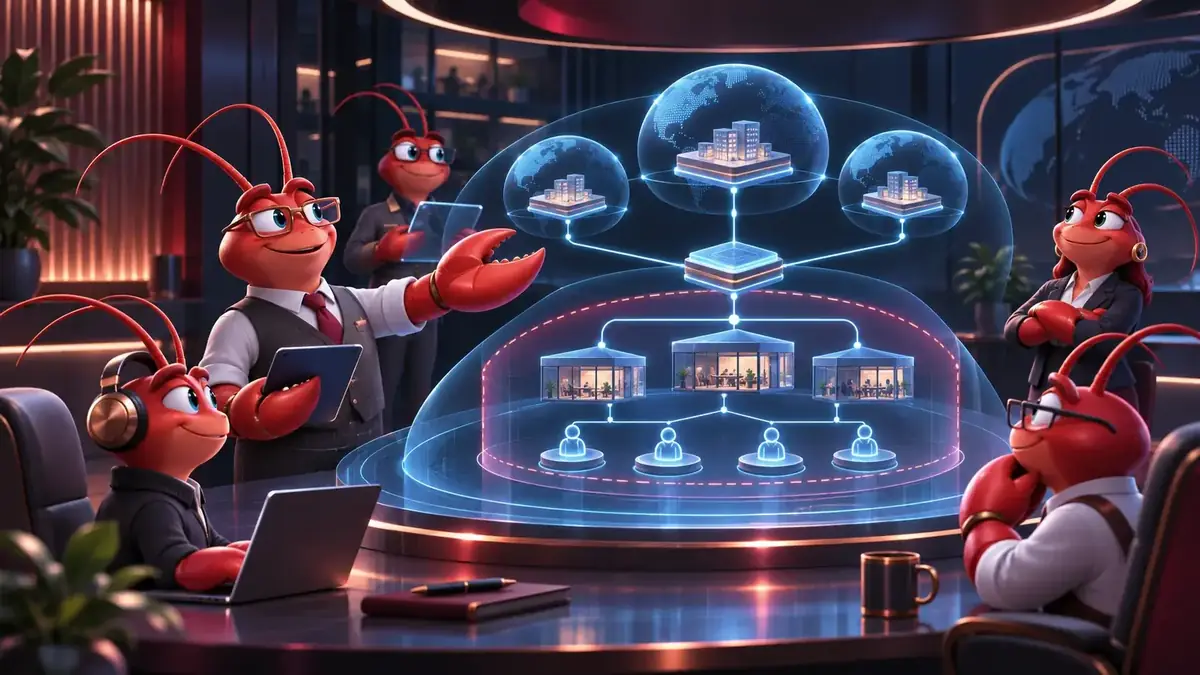
Illustration of the world and gateway hierarchy being examined by the Clawsolator lobster team
WORLD SYSTEMS / TRUST BOUNDARIES CONCEPT ART
XERXES Clawsolator / Architecture / Gateway Worlds

One platform. Multiple gateway worlds. Clear trust boundaries.

Map sites, OpenClaw gateway instances, protected domains, functional offices and specialist agents without confusing an attractive visual diagram with actual isolation.

How the worlds are organized

Planet is the interface. Policy is the boundary.

A visual world represents a Site—a physical or virtual installation. A site can contain one or more gateways. Each gateway can host many agent instances, while protected domains define what must remain segregated through actual identity, storage and tool policies. Offices are functional groups, not security controls.

Site / World→Gateway instance→Protected domain→Office→Agent

Important: A separate gateway does not automatically isolate the host, and two domain cards sharing a gateway are not automatically confidential from each other. Enforce filesystem, credentials, network, agent tool permissions, session, container and operator policy boundaries independently.

WORLD 02 / EXAMPLE

Organization Site

Company operations where legal records, media publishing and executive functions require deliberate separation.

Operations gateway(s)Can be split into separate gateways for stronger compartmentalization when justified
Explore Business Offices →
WORLD 03 / EXAMPLE

Engineering Site

Technical operations and bounded test environments, with agent requests separate from execution authority.

Development gatewayDedicated instance with separate configuration, state and ports when required
Explore Technical Offices →
When do you need another OpenClaw gateway?

One gateway, multiple agents

Usually the simpler choice: agent IDs, workspaces, sessions and routing bindings organize multiple specialist agents in one gateway process. Configure per-agent tool and sandbox restrictions and audit the actual limits.

Separate gateways

Consider a separate instance for disaster recovery, incompatible environments, or stronger separation. Give every gateway distinct configuration and state directories, workspaces, ports and service profiles; verify host- and credential-level boundaries too.

One site, several domains

Legal matters, customer data, personal information and production systems may need separate domains even if they appear within one visual site. Do not imply enforcement without approved controls and verification.

Cross-world handoffs

A Reporter can propose a publishing request, or a Trainer can submit a scheduling suggestion. Transfers between gateways or domains require explicit, scoped interfaces and audit trails—not implicit shared access.

Are Clawsolator worlds separate servers?

Not necessarily. Worlds visualize Sites. A Site may represent a host, VM or installation; multiple gateways can operate on one host with separately configured runtime state.

Does each agent require its own gateway?

No. OpenClaw supports multiple agents in a single gateway. Separate gateways are situational tools, not a default requirement for every role.

Does a separate gateway make an agent safe by itself?

No. Gateway separation can reduce accidental shared-state risks, but privileged sockets, host filesystem access, secrets, network exposure and human approval rules still require their own enforcement.

Sources: OpenClaw multi-agent documentation · Multiple gateways and isolation checklist · Gateway configuration. These are architecture examples, not a claim that every pictured agent or gateway is deployed.

Browse the Agent Atlas